4x4 and Pickup Brands That Are Not Sold in Europe
Two out of every three real off-road vehicles sold today worldwide cannot be bought new in Europe. We are not talking about exotic prototypes or marginal oddities, but about working pickups and 4x4s that operate normally in the United States, Australia, South Africa or Latin America.
According to cross-analysis of market data and regulations, between 61% and 66.7% of high-capacity 4x4 and pickup models sold globally have no official presence in the European Union. The figure is not rhetorical: it is structural.
This is the harshest conclusion. The truly affected buyer is no longer the low-income consumer, but the average-income buyer. For the middle class, the new 4x4 has ceased to exist. It is no longer a viable option. What remains is the second-hand market, complicated imports, expensive and uncertain individual homologation procedures, or direct renunciation.
Here is the exact original question posed to the AIs upon which the answers were generated:
“I want to know all 4x4 cars and pickup trucks that are manufactured or sold in the United States, South America, South Africa and Australia.
First definition: what is a 4x4 to me? To fulfil this condition they must have high range, low range (or reduction gearbox) and, at minimum, a centre lock. We will also understand as ‘centre lock’ those vehicles that are 2x4, that can run in 2x4 mode, but can also engage 4x4 mode. We will consider that all 2x4 vehicles capable of engaging 4x4 mode have a centre lock. These are the minimum entry requirements; if they have more lockable differentials, even better, but to be included they must comply.
I want the most exhaustive list possible. We will include all cars, brands, models and versions that are sold in those countries but are not sold in Europe. If there is a model, for example the Ford Bronco, that has versions sold in those markets but not in Europe, we must consider it as a model that is not sold in Europe.
The objective is to know which cars, brands, models and versions are not sold in Europe and why. If they are not sold due to legal reasons — such as pollution or safety — or for market analysis and business decisions. I also want to know which models are sold here, and in which cases there are quotas due to environmental or green regulations.
I want the most exhaustive study possible: match brand and model with the reason why they do not come to Europe.
Among all these brands and models we will not consider Chinese brands. For me, a Chinese brand is any car whose ultimate parent company is Chinese, unless the brand was originally European, American or Japanese. For example, Volvo will never be considered Chinese to me, because it was originally European.
Therefore, any brand that is not originally and commercially Chinese will be included. We will not include in this study any brand that is strictly Chinese by birth.
I want a study as detailed and exhaustive as possible of brands, models and versions marketed over the last five years to today, as well as expectations over the next three years.”
Toyota
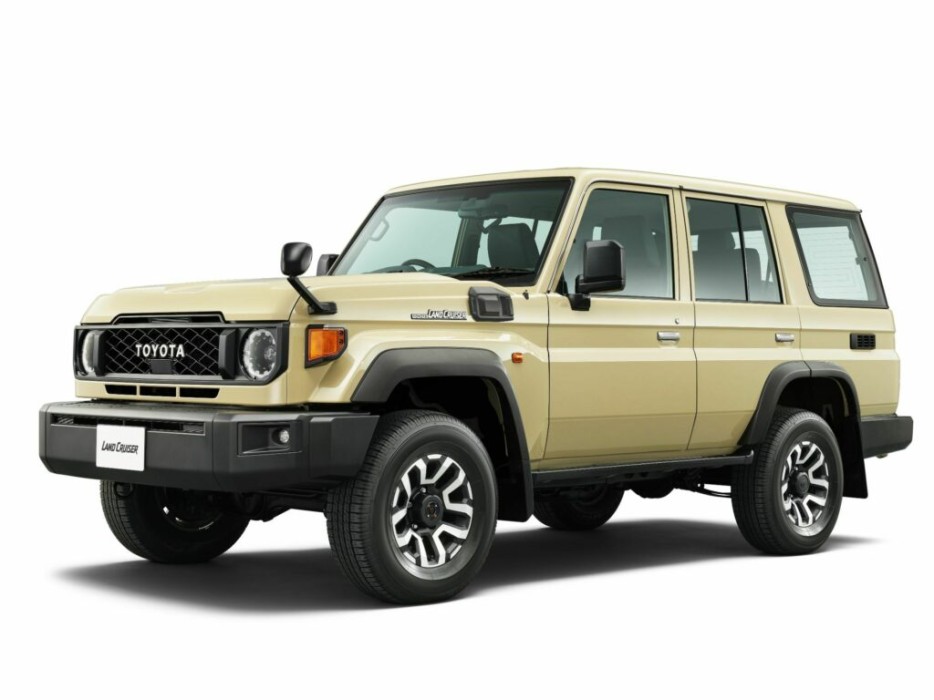
1. Land Cruiser 70 Series (HZJ/GRJ/VDJ)
Type: hardcore 4x4, ladder chassis, low range, lockers depending on version.
Recent markets: Australia, South Africa, multiple African countries, Middle East, parts of Latin America.
Europe: Toyota stopped selling the 70 officially years ago; today it only enters Europe through parallel import.
Reasons for absence:
Emissions and EU safety: the 70 is designed as a simple workhorse, with a robust but polluting diesel engine, lacking advanced European safety systems (GSR2, etc.). The cost of modernising an old ladder-frame platform to comply with full European safety requirements (side airbags, ADAS, pedestrian protection) does not compensate for the volume expected.
2. Land Cruiser 300 (J300) Type: full-size ladder-frame SUV, successor to the 200, low range and lockers depending on version.
Markets: Japan, Middle East, Australia, parts of Asia and Africa.
Europe: Toyota states clearly that the 300 is not available in Europe; the LC 250/Prado is launched instead.
Reasons: COâ and weight: a >2.5-ton giant with powerful engines destroys fleet average emissions. Toyota Europe prefers Prado/LC 250 and Highlander/RAV4 rather than importing the 300 for tiny volumes that would penalise the whole emissions pool.
3. Fortuner / SW4 (Hilux-based SUV) Type: ladder-frame Hilux SUV, low range true 4x4.
Markets: Asia, Africa, Middle East, Latin America, Australia.
Europe: never sold officially.
Reasons: Europe already had Land Cruiser Prado for the BOF segment; Fortuner would cannibalise Prado. Adapting Fortuner to EU safety/ADAS rules for tiny volumes is not financially viable.
4. 4Runner Type: ladder-frame SUV, low range and strong off-road credibility (Tacoma relative).
Markets: USA, Canada, Latin America.
Europe: never part of EU lineup; only via import.
Reasons: Overlap with Prado makes no sense for Toyota Europe.
5 & 6. Sequoia and Tundra Type: full-size BOF SUV and full-size pickup.
Markets: North America mainly.
Europe: not in European Toyota lineup.
Reasons: Size and COâ conflict with EU regulations and urban realities. Toyota uses Hilux as the EU pickup offering to avoid fleet-penalty disasters.
Nissan
7. Patrol Y62 Type: full-size BOF SUV, V8 petrol, real 4x4 with low range.
Markets: Middle East, Australia, parts of Asia/Africa.
Europe: not sold.
Reasons: Developed for Middle Eastern and Australian conditions, not EU rules. Too inefficient for EU emissions and too niche.
8. Titan Type: full-size pickup, low range.
Markets: USA, small presence in Middle East.
Europe: never sold.
Reasons: Same issues as Tundra: size, emissions, niche.
Ford
9. Bronco (2-door, 4-door, Bronco Raptor) Included because versions sold in USA are not coming to Europe.
Markets: USA, Canada, some LATAM/ME import routes.
Europe: Ford Europe does not sell the real Bronco here.
Reasons: Homologation costs and fleet COâ impact make it unviable.
10. F-150 / Super Duty (F-250, F-350…) Type: full-size pickups with low range.
Markets: North America, Mexico, Middle East, LATAM.
Europe: not sold officially; only via importers.
Reasons: EU fleet emissions and size/weight constraints.
11. Everest (Ranger-based SUV)
Markets: Asia-Pacific, Australia, Africa.
Europe: explicitly rejected for Europe.
Reasons: EU COâ penalties + niche demand.
Stellantis / RAM / Jeep
12, 13 y 14 RAM 1500 / 2500 / 3500 Type: full-size pickups with low range.
Markets: USA, Canada, Mexico, LATAM, ME.
Europe: only through IVA import route.
Reasons: COâ ~340–350 g/km, impossible for EU fleet standards. Easier to keep RAM as niche import without mixing with Peugeot/Opel/Fiat emissions.
15 y 16 Jeep Wrangler / Gladiator — important nuance
Wrangler was officially sold in Europe. Gladiator sold officially in Germany and a few other places in tiny numbers.
Wrangler will cease EU thermal sales by 2026 due to new emission and safety rules, while it stays alive in USA.
Isuzu / Mazda
17. Isuzu MU-X Type: BOF SUV with low range.
Markets: Thailand, Australia, South Africa, Middle East, Central America, Asia.
Europe: not sold officially.
Reasons: Tiny EU market niche for diesel BOF SUV.
18. Mazda BT-50 Type: mid-size pickup, low range.
Markets: Australia, Oceania, SE Asia, LATAM, Africa, ME.
Europe: not sold today.
Reasons: Industrial agreements with Ford + marginal dealer network.
Mitsubishi
19. Pajero Sport / Montero Sport / Shogun Sport
Markets: Australia (until 2025), South Africa, Brazil, Mexico, SE Asia.
Europe: sold as Shogun Sport in UK until 2021; no longer sold in Europe.
Reasons: Mitsubishi retreat from Europe + expensive safety adaptation for tiny volumes.
Other regional BOF SUVs not sold in EU
20 Chevrolet Trailblazer (Colorado-based PPV)
21 Toyota SW4 (LatAm Fortuner) Mahindra Scorpio-N / Pik-Up and multiple Asian BOF derivatives
Why don’t they come to Europe? Key reasons
* Fleet CO2 emissions laws Selling a RAM/Tundra/LC70 would destroy manufacturer fleet averages.
* GSR2 and ADAS safety laws Mandatory systems and pedestrian rules make BOF export costly.
* Homologation type-approval costs Full EU type-approval is expensive for small-volume off-roaders.
* Market logic Europe prefers SUVs, EVs and hybrids over work pickups.
* Internal brand overlap Toyota selling LC300, LC250, Fortuner, 4Runner and Hilux in the same continent makes no sense.
* Electrification strategy European brands want a green public image, not V8 BOFs.
Are there environmental quotas?
There are no official EU quotas by model. What exists is fleet COâ emission budgeting per manufacturer. This acts as a quota by cost.
Case studies – 2026 models
Ford Ranger Heavy-Duty 2026
Huge working pickup with lockers, low range, reinforced chassis. Only for Australia.
Reasons: CO2 impact, overlap with Ranger EU models, niche demand.
“Baby Land Cruiser / FJ”
Small 3-door BOF off-roader revealed in Japan. Not coming to Europe due to COâ strategy.
Tesla Cybertruck
Not approved for EU sale due to pedestrian safety and homologation issues.
Conclusion
This exclusion of two-thirds of the global specialist 4x4 market is a direct result of strict fleet emissions and new GSR2 safety standards. These barriers make official import impossible for most American full-size and legacy designs (LC70, FJ), leaving Europe only with high-margin premium options (G-Class, Grenadier) or mid-size platforms that invested heavily in Euro 6d/7 compliance (LC250, Ranger Raptor).
The practical consequence is visible in dealerships: the new 4x4 in Europe is no longer, except for specific cases, an accessible working vehicle. It has become a premium object. The models that survive the hardcore segment exceed 80, 90 or even 100 thousand euros. Extraordinary machines technically, yes, but out of reach for many who once relied on this category of vehicle.
No ideological interpretation is required. The effect is purely economic. When entry prices multiply, a vehicle ceases to exist for those who cannot afford it. And when this happens systematically, the market reorganises by income.
The high-income buyer barely notices a barrier: they can pay the technological cost and regulatory complexity. But for the average buyer, the new 4x4 has disappeared.
Thus, a vehicle that for decades was a cross-sector working tool — used by farmers, forestry workers, maintenance contractors and rural professionals — has been transformed into an object reserved for the wealthy. Not due to natural demand evolution, but due to a profound shift in regulatory frameworks.
That is the cold and verifiable result: current regulation does not eliminate the 4x4, but pushes it from the functional sphere into the world of economic privilege. The vehicle still exists, with levels of capability never seen before, but it is no longer accessible to those who once needed it.
 Share
Share